Prediction Market Prices, Explained as Odds
A prediction market contract that costs 60 cents is a bet at -150 odds. The price is the probability, written in cents. Once you can convert one into the other, you can compare any prediction market to any sportsbook and see what each one actually charges you.
How the contract works
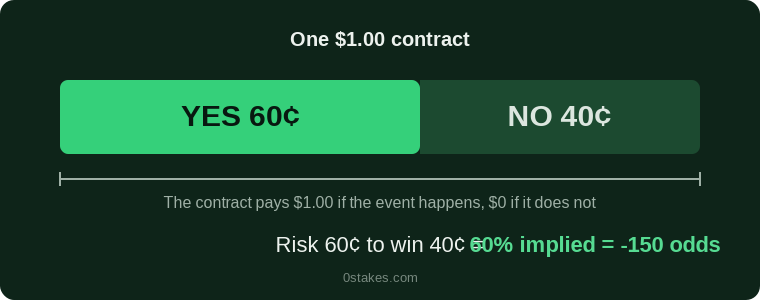
Platforms like Kalshi and Polymarket sell contracts on a yes or no question, such as "Will this team win?" Each contract pays $1.00 if the answer is yes and $0 if it is no. You can buy either side, and the two sides always add up to $1.00 at fair value.
- Buy YES at 60 cents. If yes happens, you collect $1.00, a profit of 40 cents.
- If no happens, you lose the 60 cents.
- Buying NO at 40 cents is the mirror image.
Price is implied probability
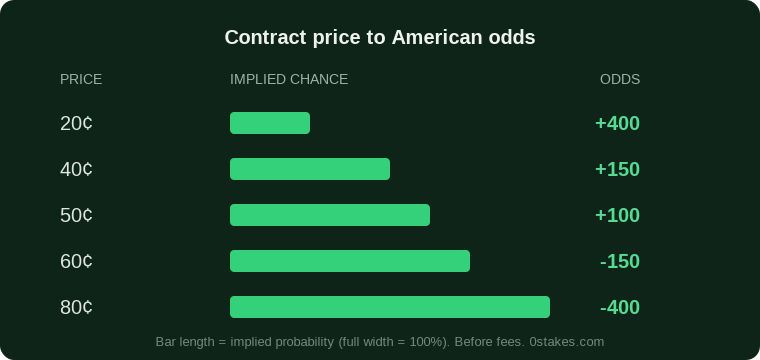
If you pay 60 cents for something that pays $1.00, you break even only if it happens 60% of the time. So the price is the market's probability: 60 cents means 60%.
The conversion to odds takes two lines of arithmetic:
- Favorite (price above 50 cents): American odds = -(price / (1 - price)) x 100. At 60 cents: -(0.60 / 0.40) x 100 = -150.
- Underdog (price below 50 cents): American odds = +((1 - price) / price) x 100. At 40 cents: +(0.60 / 0.40) x 100 = +150.
- Decimal odds are 1 divided by the price. At 40 cents that is 2.50.
Where the cost hides
A fair market would let you buy YES and NO for exactly $1.00 combined. Real markets do not. There is a gap between what buyers pay and what sellers accept, plus a platform fee on top.
Say YES costs 52 cents and NO costs 52 cents. Together that is $1.04 for something that pays $1.00.
- Paying 52 cents to win 48 is odds of -108, and you need to win 52% of the time to break even on each side.
- The 4 cent gap works out to a built-in cost of about 3.8%.
A standard sportsbook line of -110 on both sides works the same way. Each side implies 52.38%, the two add up to 104.76%, and the book's hold is about 4.5%. The labels differ. The mechanism is the same: you are always paying more than the true chance to get a payout. Prediction markets often have a tighter gap on popular markets and a wider one on thin ones, and fees vary by platform and market, so check the current fee schedule before you compare.
What an edge looks like
Expected value per contract is your true probability minus the price you pay. If you believe an outcome is 55% likely and the contract costs 52 cents:
- EV = 0.55 x $1.00 - $0.52 = +$0.03 per contract, or about 5.8% of the amount risked.
- A 1 cent fee on that trade cuts the edge by a third.
The catch is the first number. The market price is already the crowd's estimate, so you only profit if your 55% is better than theirs. Most people are not better than the market, which is why most traders lose after costs, just as most sportsbook bettors do.
Longshots are the expensive end
Cheap contracts feel like a bargain. A 5 cent contract that pays $1.00 looks like a 20 to 1 shot. But a 1 cent fee on a 5 cent contract is a 20% surcharge on the price. Research on betting markets has repeatedly found that longshots are overpriced relative to how often they win, while favorites are priced closer to their true chance.
Where the law stands (November 2026)
Two federal appeals courts have given opposite answers on whether Kalshi's sports contracts are gambling under state law. The Third Circuit said federal law protects them. The Ninth Circuit said Nevada can enforce its gambling laws. The rules depend on where you live, and the Supreme Court may step in. Read the full breakdown in Is Kalshi Sports Betting Legal? The Court Fight, Explained.
The takeaway
Convert every price to a probability first. Then ask two questions: is my estimate better than the market's, and is the gap bigger than the cost to trade? If you cannot answer yes to both, you are paying the house edge under a different name.
To see how those costs add up over time, read the house edge guide and the bankroll management guide, then practice with free chips in the 0stakes games. Prediction markets involve real money and are not available to everyone. If gambling is a problem for you, call 1-800-GAMBLER.