The New Gambling Loss Tax Rule: What 90% Costs You
This is general information, not tax advice. Rules differ by state and by situation, so check with a tax professional before you file.
Starting with the 2026 tax year, you can deduct only 90% of your gambling losses. The other 10% is gone for good. That means a bettor who breaks even can owe tax on money they never made, and a bettor who loses a little can owe tax too.
What changed
The One Big Beautiful Bill Act, signed in July 2025, changed how gambling losses work for tax years beginning after December 31, 2025.
- Old rule: deduct gambling losses up to the amount of your gambling winnings.
- New rule: deduct the lesser of 90% of your losses or your winnings.
- No carryover: the disallowed 10% cannot be carried forward or used against other income.
- Still required: you must itemize on Schedule A, and you must keep records of both wins and losses.
- Professionals: the 90% limit applies to professional gamblers too. According to Withum, a CPA firm, a professional's wagering losses and ordinary gambling business expenses are combined under the same cap.
If you take the standard deduction, nothing changes for you. You never got a deduction for losses, and winnings are fully taxable either way.
The break-even bettor
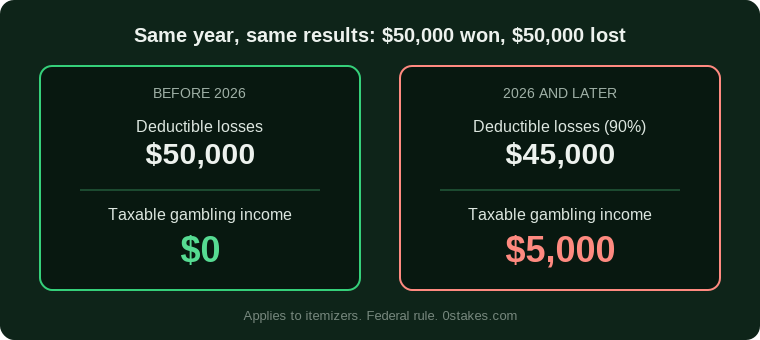
The simplest case is the one in the graphic above. You win $50,000 and lose $50,000 over the year. You are exactly even.
- Before 2026: deductible losses of $50,000 wipe out the $50,000 in winnings. Taxable gambling income is $0.
- 2026 and later: deductible losses are 90% of $50,000, or $45,000. Taxable gambling income is $5,000.
The tax law treats you as having a $5,000 profit. You did not make one.
What it costs, by tax bracket
The extra taxable income is always 10% of your losses, as long as your losses are under about 111% of your winnings. The cost is that amount times your federal marginal rate. For the $50,000 break-even example:
| Federal marginal rate | Extra tax |
|---|---|
| 10% | $500 |
| 12% | $600 |
| 22% | $1,100 |
| 24% | $1,200 |
| 32% | $1,600 |
| 35% | $1,750 |
| 37% | $1,850 |
These are federal figures only, and your bracket depends on your income and filing status. Your state may add its own tax.
You can lose money and still owe tax
This is the part that surprises people. Say you win $50,000 over the year and lose $52,000. You are down $2,000.
- Deductible losses: 90% of $52,000 = $46,800.
- Taxable gambling income: $50,000 - $46,800 = $3,200.
At a 24% rate that is $768 in federal tax, on a year where you lost $2,000. A typical sportsbook bettor loses a few percent of what they wager, so the person this rule hits hardest is the high-volume bettor who ends up close to even or slightly down.
Who is not hit
The rule stops costing you once your losses reach about 111% of your winnings. At that point 90% of your losses equals your winnings, so the whole amount is offset.
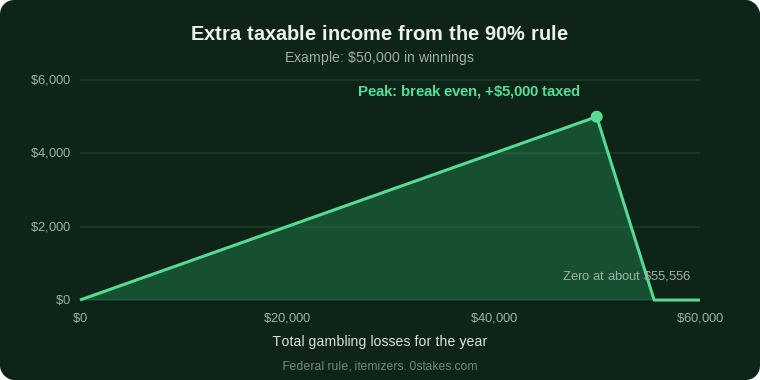
- Net winners pay extra, always 10% of their losses.
- Break-even bettors pay the most, relative to their real profit.
- People who lose heavily (more than about 11% more than they win) are not affected.
- Standard-deduction filers are not affected, because there is no loss deduction to cut.
Where states stand
States decide for themselves whether to follow the federal rule. Nevada and Texas have no state income tax on gambling winnings. Illinois and Kansas tax gross winnings with no loss deduction at all. Missouri generally follows the federal rule, allowing losses up to winnings. A state that does not conform to the 90% limit keeps its own treatment, so check yours.
Could it be reversed?
The FAIR BET Act, introduced by Nevada Congresswoman Dina Titus, would repeal the 90% limit and restore the full deduction. As of the sources we read, it has not been enacted. Until it passes, plan for the 90% rule.
What to do about it
- Keep a session log. Record the date, place, amount won and amount lost for each session, and keep tickets, statements and account histories. The IRS requires records of both winnings and losses.
- Remember all winnings are taxable. The IRS says gambling winnings are fully taxable and must be reported whether or not you receive a Form W-2G.
- Revisit estimated payments. If you bet a lot, the new rule can raise your tax bill, and an estimate that assumed the old rule may fall short.
- Talk to a tax professional, especially if you bet for a living or in a state that taxes gross winnings.
The takeaway
The 90% rule is a built-in cost on top of whatever the house already takes. You can see how those costs add up in the house edge guide, and for the prediction market version of the same math, read how to read prediction market prices as odds. To practice without risking a cent, try the 0stakes games. 0stakes involves no real money. If gambling is a problem for you, call 1-800-GAMBLER.
Sources
- Withum, "2026 Gambling Tax Reform: What Frequent Gamblers Should Consider Now," November 2, 2026: withum.com
- Thompson Coburn, "Sports Betting and 2026 Income Tax Changes," August 11, 2026: thompsoncoburn.com
- IRS, "Topic no. 419, Gambling income and losses": irs.gov