Is Kalshi Sports Betting Legal? The Court Fight, Explained
This is a fast-moving case. Check the sources at the bottom for anything newer.
Two federal appeals courts have looked at the same Kalshi sports contracts and reached opposite answers. The Third Circuit said federal law protects them. The Ninth Circuit said states can regulate them as gambling. Until the Supreme Court settles it, whether Kalshi sports betting is legal depends on where you are.
The question in one line
Kalshi runs an exchange registered with the federal Commodity Futures Trading Commission (CFTC). It lists contracts on sports outcomes. The whole fight turns on one label.
- If the contracts are swaps, the CFTC has exclusive jurisdiction and federal law overrides state gambling rules.
- If they are sports gambling, states and tribes can license, restrict or ban them like any other sportsbook.
For how the contracts themselves work, see how to read prediction market prices as odds.
Court one: the Third Circuit says swaps
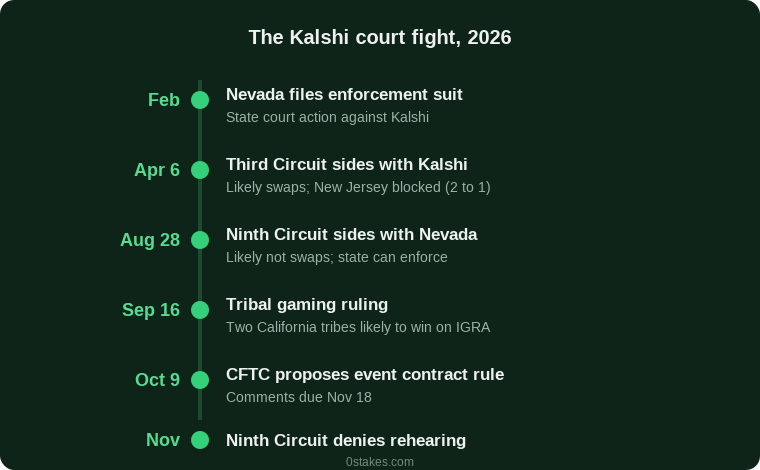
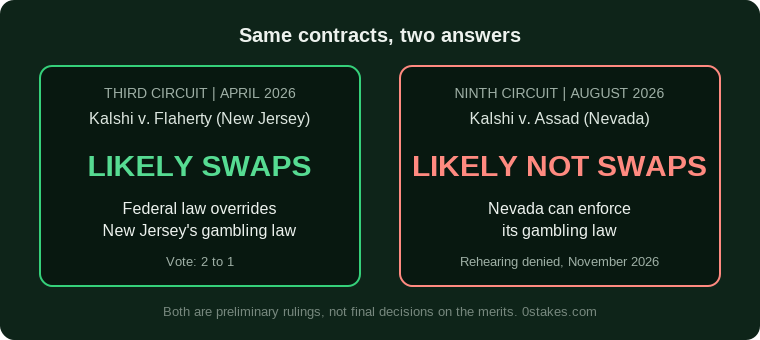
On April 6, 2026, the Third Circuit decided KalshiEX v. Flaherty, a case against New Jersey's gaming regulator. The vote was 2 to 1. The court upheld an order that stops New Jersey from enforcing its gambling laws against Kalshi's sports contracts.
- The holding: the contracts are likely swaps, and the federal Commodity Exchange Act preempts New Jersey's gambling laws as applied to contracts traded on a CFTC-registered exchange.
- The reasoning: a swap can pay out on an event that is merely "associated with" an economic consequence. The majority said sports outcomes qualify because games affect sponsors, broadcasters and franchises.
- The dissent: Judge Jane Roth called the contracts virtually indistinguishable from sportsbook bets.
- What it left open: the court did not decide whether federal law preempts all state gambling regulation.
Court two: the Ninth Circuit says gambling
On August 28, 2026, the Ninth Circuit decided KalshiEX v. Assad, a case about Nevada. It went the other way. Kalshi had not shown that federal law likely preempts Nevada's gambling laws, so Nevada can enforce them.
- The holding: the contracts are likely not swaps.
- The reasoning: the court said the substance of the contracts is sports gambling "regardless of whether Kalshi calls them swaps." Swaps normally help institutions hedge risk. These contracts "create risk, largely for ordinary consumers," in the court's words.
- The economic-effects argument: the court rejected Kalshi's point that games affect broadcasters and sponsors, because that logic would make almost any bet a swap.
- A federal rule: the court also leaned on CFTC Rule 40.11, which says exchanges shall not list contracts relating to gaming.
- The concurrence: Judge Kenneth Lee agreed with the result but said the CFTC can treat some sports events as swap trades. He said the court did not need to resolve that because Rule 40.11 still applies.
Why this is a real split
Both courts agreed that the answer depends on whether the contracts are swaps. They read the same statute and disagreed. Legal analysts at Katten called the Ninth Circuit ruling a direct circuit split on both questions. Both decisions came at the preliminary stage, so neither is a final ruling on the merits. That is part of why the Supreme Court may wait for a more developed case.
Where Nevada stands
Nevada has been the most aggressive state. Its gaming regulator ordered Kalshi to stop offering sports contracts in 2025 and filed a civil enforcement suit in state court in February 2026. In early November 2026 the Ninth Circuit denied Kalshi's request for a rehearing, with no judge asking for a vote by the full court. Kalshi is no longer protected against Nevada enforcement while the case continues. It has 90 days from the denial to ask the Supreme Court to take the case.
The tribal front
A separate Ninth Circuit ruling on September 16, 2026, Blue Lake Rancheria v. Kalshi, involved two California tribes. The court held the tribes are likely to succeed in arguing that Kalshi's sports contracts on their lands violate the federal Indian Gaming Regulatory Act. The court said a bet is placed where the user sits, so a user on tribal land is gambling there. The ruling sends the case back to the lower court to decide whether to issue an order. It matters because it does not rely on the swap question at all.
What happens next
- The Supreme Court. As of a September 2026 legal analysis, three petitions were pending, from New Jersey, Crypto.com and Robinhood. We did not find a ruling on whether the Court will take the case, so check its docket.
- The CFTC. On October 9, 2026, the agency issued a proposed rule and a companion interim final rule on event contracts, with public comments due November 18. The agency's chair has said event contracts are commodity derivatives within its remit, and the agency backed Crypto.com against Nevada.
- Kalshi's next move. Its lawyers may ask the Supreme Court to take the Nevada case, or try to delay until the CFTC rule is final.
What this means if you trade on Kalshi
Treat this as background, not legal advice.
- In the Third Circuit states (New Jersey, Pennsylvania, Delaware), Kalshi's sports contracts are currently protected by a preliminary ruling.
- In Nevada, they are not.
- Everywhere else the question is unsettled, and some states and tribes are actively fighting it.
- A final Supreme Court ruling could change the picture in either direction.
Whatever the court decides about the label, the math does not change. A contract still has a cost built into its price. To see what that cost looks like, read the house edge guide and practice the math with free chips in the 0stakes games. 0stakes involves no real money. If gambling is a problem for you, call 1-800-GAMBLER.
Sources
These are law-firm and trade-press summaries of the opinions, not the opinions themselves. Check the full text for exact language.
- Holland & Knight on the Third Circuit ruling, April 7, 2026: Federal Appeals Court: CFTC Jurisdiction Over Sports Event Contracts Likely Exclusive
- Katten on the Ninth Circuit ruling, August 28, 2026: Sports Bets or Swaps? Ninth Circuit's Controversial Kalshi Ruling Deepens the Divide
- Buchalter on the tribal ruling, September 21, 2026: Ninth Circuit: Kalshi's Sports Contracts Are Class III Gaming on Tribal Land
- Withers on the Supreme Court petitions, September 24, 2026: The preemption gap in prediction market high court petitions
- CDC Gaming on the rehearing denial, November 4, 2026: U.S. appeals court denies Kalshi's petition for rehearing in Nevada case
- Cointelegraph on Nevada's enforcement action, February 18, 2026: Nevada sues Kalshi after prediction market loses bid to stop state action